
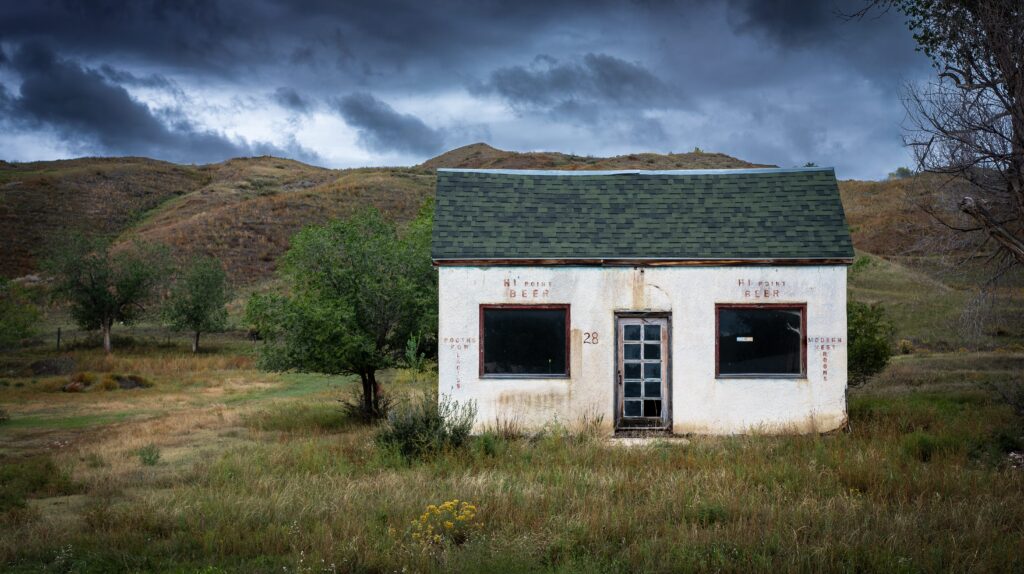
No one remembered the bar’s real name.
The hand-painted signage had peeled away from the side of the building long ago. Long before Interstate 90 was built. Long before when cross-country, long-haul trucks stopped for a brief rest before heading over the mountain pass. Long before the small outpost building faded away into the landscape. But those who knew its history still called it Old 28 because of the faded red number painted beside the front door.
80 years ago, a woman named Jane owned the bar. Jane was a widow and inherited the place from her husband, who was killed during the war. She had a no-nonsense approach to life, but a soft voice who welcomed everyone. The tattered liquor license was nailed to the wall behind the counter, next to the dusty bottles of whiskey, rye, and unknown clear elixirs. She sold cold beer, sandwiches she made by hand every morning, and coffee strong enough to carry a person through a winter storm. The Old 28 was never fancy. It was always a simple building with two windows, a narrow door, and plain, easy-to-understand hand-painted signage directly on the exterior walls. It was clear to see that Jane offered “Hi Point Beer.” And next to both windows, the building proudly boasted the best in creature comforts: “Modern Rest Rooms” and “Booths For Ladies.” Even in its heyday, the Old 28 smelled of dust, must, and wet cardboard.
But it was always warm and welcoming.
After a long day, workers came in with dust on their boots to have a beer and complain about the boss. Travelers on old Highway 16 stopped for directions, weather reports, a sandwich, or simply an excuse to sit awhile.
Then, the Interstate system brought high-speed travel and less desire to stop.
Almost overnight, the visitors stopped coming. The gentle whir of the beer cooler began to be louder than the conversation. Jane kept the place open for a few more years, mostly because she had nothing else to do. On her final night of running the Old 28, she poured the last whiskey bottle into small glasses and told the three local customers at the counter that nobody owed her a thing.
By morning, the door was locked.
Over the years, the building went through various stages of abandonment. Jane eventually died, and the land passed to new owners, who turned it into storage for old, unwanted junk. Locals claimed that during thunderstorms, a weak amber light still glowed through the empty windows. Some believed that Jane had never truly left—that she still stood behind the varnished counter, pouring one last drink for anyone who needed it.
On certain dark evenings, when rain sweeps across the hills and the Interstate disappears into the distance, the abandoned building doesn’t look empty at all.
It looks like it is waiting.
Share this article


